Saturday, 7 November 2020

Publication and exciting times on the radio and in the press

Other than some satnav shenanigans as a result of a closed road in Grantham, my trip to the binders in Derbyshire went as smoothly as could be expected - not least because the book looks fantastic! I'm really pleased with the way it has turned out. If you had told me at the start of all this that this would be how it would look, I would have been amazed, and after all that has gone into making it over the last three years it was quite a thing to actually, finally, hold it in my hands. Of course the work doesn't stop with publication and behind the scenes I have been working with my printers to come up with a distribution plan for whatever might be thrown at us in terms of orders - and the possibility that things might get 'interesting' on that front has been vastly increased by the brilliant and persistent work of my publicist Angela. Here is what is coming up:

  • Saturday 7th November: 4-page feature in the Telegraph magazine
  • Tuesday 10th November: 9.05 a.m. interview on BFBS radio
  • Wednesday 11th November: interview along with William Boyd on the Today programme on Radio 4 (time still to be confirmed).
  • Wednesday 11th November: publication of Country Life magazine with 'I Shall Not Be Away Long' as their book of the week.
And over the last couple of days I have been sending out review copies at the request of the book editors of, in order of their asking:
  • The Observer
  • The Daily Mail
  • The Sunday Times
Given the huge number of books that are being published at the moment and the limited space for reviews in those papers, that really is quite something. I don't know when the reviews will be coming out but I will post on here when I've got some concrete news. I couldn't have hoped for more - and yet there still may be more - I'll let you know when I know for sure.

I'm aware that some people are not keen on using Paypal or cheques, and now that I've got some actual books there is another option: the book is now listed on Amazon marketplace. The orders still come through to me to organise posting out and with the tight margins on all this I'm afraid the extra fees I have to pay to Amazon are reflected in the fact that the £2.80 fee for P&P is on top of the £29.50 you'd pay if buying direct through my website.

The story with posting out the books is that I brought 70 copies home from the binders and am using those to post out review copies as well as the orders I've had from abroad. With the required customs form needing a signature, it seemed that I had to do it myself and so over the next few days I'll be posting books to Ireland, the Netherlands, France, Spain, Germany, Switzerland, Bermuda, Canada, Australia, South Africa and the USA. Orders for this country will be going out this week once the full shipment of newly-bound books arrives back at my printers in Ipswich. The waiting is nearly over for all the kind people who've pre-ordered my book over the last couple of months.

And finally, on my way back from the binders on Wednesday I stopped off at Majestic Wines in King's Lynn and took advantage of a great deal to buy a bottle of Louis Roederer Brut Premier champagne (see a previous post for its significance). Luckily it was the night before lockdown so I was still able to stop off at my friend Paul's. He did his trick of wrapping the bottle in a wet towel and sticking it in the freezer and half an hour later we were toasting the book and each other. It's been quite a journey and Paul has been with me every step of the way. I wonder what is going to happen next.


Monday, 2 November 2020

On the brink again, with fantastic printing and publicity

I have recently re-discovered the truth of the saying ‘life is what happens to you while you’re busy making other plans’. At the beginning of my last post I said that ‘There will be no more tweaking or correcting or fine-tuning’ of my new book. That lasted about 16 hours. I went down to Ipswich to see the start of printing. Item One was the inside of the cover with the maps and list of supporters. A little on-press tweak led to a result that just gave me a huge lift, seeing that it had come out just as I meant it to be (for those not familiar with the vagaries of colour printing: just because something looks good on screen or in a proof doesn’t mean it will look the same amount of good when you print it on the press). Next was the outside of the cover. Again there was a little on-press tweak and things appeared to be OK until I was then shown the result of applying the anti-scuff laminate to the outside (this is essential to protect the cover and hold the creases for the spine and flaps without cracking the card). It was just too dark. The cover is supposed to have a dirty feel to evoke the circumstances in which the letters were written, but there is also meant to be a warmth and lightness that reflects the human spirit at the heart of the book and that just wasn’t there. I made a brief attempt to see if I could make adjustments to the original artwork whilst on site but given that the outside cover alone contains 55 image files and the computer I would have to work on was not running Windows as I was used to, it wasn’t long before I came to the decision that I was going to have to sort it out at home. So after seeing prints of the first few pages from inside the book, I headed back up to Norfolk. 

The next day I produced 12 alternative versions for the outside cover. A rigorous comparison and selection procedure narrowed that down to 3 (two with subtle changes and one with something more extreme in case subtle was not enough). I sent them off and they were printed on the press as a composite alongside the original on Thursday. I waited in for the courier on Friday. No show. I agonised over the weekend. I waited in for the courier on Monday. No show. Two more sets were sent out to me by different couriers. All three sets arrived within an hour of each other on Tuesday morning. And then I had to work out which version was best! I was just too close to the work to decide so I rang my friend Paul who has been with me every step of the way with this book. No answer. I rang the Library. He was there. I drove in to Fakenham and one confabulation later I had a decision as well as a telling-off from one of my ex-work-mates for using the Library as a meeting place in this time of Covid. Completely justified but it’s been difficult to keep thinking of the bigger picture when I’ve got so much riding on this book. 3 years of work plus 42 hours of press time plus a cost of £29,000 is an awful lot to put into something for it to come out less than perfect. And of course perfection is not achievable (at least not without driving everyone completely round the twist). 

The whole process is like buying a house in that it is very stressful because it is such a rarely-done big thing that one is not an expert in and there is the constant feeling that something important might be being missed. Even working with experienced high-quality printers is no guarantee of good results because they are generally used to working with professional designers who are au fait with the way things are supposed to be done, rather than someone like me who has got a pretty good idea of the process but is basically self-taught (and who is pushing the boundaries of things with layered and transparent images). It is also too much to expect of printers to spot the nuances that are important to a designer who has such familiarity with the material having concentrated so much effort into it. 

I am therefore delighted to report that the printing has turned out fantastically well – better than the proofs and better than I could have hoped for at the start of all this. I am thrilled and the icing on the cake was having two of my contacts at the printers separately telling me what a good job I’d done of the design. I’m really looking forward to hearing the reaction of readers. 

Next step in the process is binding the pages into the covers to produce the final books. My printers don’t have the machines to do thread-sewn binding in-house, so all that they have printed is going up by lorry to a binders near Derby to be bound this week. Covid has already thrown a slight spanner in the works because that area is in Tier 2 and quite understandably they are not allowing external people into the factory. The current plan is that I drive over on Wednesday then wait in the car park ready to be shown the first books as they come off the production line. Once they’ve got my go-ahead, they’ll bind the rest and I’ll head home taking some boxes of books (but not so many as to ruin the suspension on my car). The first delivery of finished books is expected to arrive back in Ipswich on 6th November, ready for my printers to dispatch, with the remainder arriving on 11th November. I’m hoping that all that stays on track despite the new lockdown that is starting on Thursday as there are some big pieces of publicity in the offing. 

Firstly reviews have come out in two magazines including these lines: 
  • ‘If there’s one book you read about the Great War during this time of remembrance, I heartily recommend this one.’ – Britain at War magazine (as part of a whole page review as their book of the month) 
  • ‘Tatham does the roller-coaster ride of Bartlett’s life proper justice in an impeccably produced book.’ – History of War magazine 
Then coming up are: 
  • On Saturday, 7th November, there will be a four-page feature in the Telegraph magazine, with their response being that they love the letters and think my book is amazing.
  • On Tuesday, 10th November, at about 9 a.m. I’m being interviewed on BFBS Radio (British Forces Broadcasting Service). 
  • On Wednesday, 11th November, Country Life magazine is featuring ‘I Shall Not Be Away Long’ as their book of the week. 
  • RNIB Connect Radio (for blind and visually-impaired people) will be having a feature based on an hour-long interview I had last week with one of their producers. This came about because I told the RNIB that I would be making a donation from the profits of this book in honour of the efforts made by Charles Bartlett (my new book’s letter writer) in his work for blind people both before and after the war. 
That any of this has been possible is due to the kindness and faith shown in me by people who have made donations and pre-ordered copies of the book (the total is now up to 450) such that I have now covered 75% of the cost of printing. It would have been a much taller order to gather up the courage to commit to spending this sort of money without this support and I am incredibly grateful. The latest donor has been from one of the companies mentioned in the book. In August 1915, Charles Bartlett wrote to his wife to ask her to send him ‘a supply of Keating’s – I have tried every shop in the place, & the powder we are served out with, well, the lice and fleas just grow fat as butter on it’. The motto of the product he asked for was ‘Keating’s Powder Kills with Ease, Bugs & Beetles, Moths & Fleas’. The story of that company is an incredible testament to the will to survive through human ingenuity. I’ll leave it for you to read in the book but you can get an idea of how far they’ve come by the fact that their parent company is now called Terahertz – and I’m very grateful that they should have thought to contribute. 

With a new lockdown imminent in amongst all the current difficulties the world is facing, I hope that my book will provide some distraction and inspiration. I would also like to recommend two books that I have recently read: 
Both achieve what I hope comes through from my book in that they warn of what can happen if we don’t pay attention and don't act soon enough against the evils of the world, and show that simple acts of kindness and love can reverberate through the ages.

'I Shall Not Be Away Long' is available via www.ishallnotbeawaylong.co.uk 

PS In the process of testing things, I’ve discovered that ‘I shall not be away long’ is not as common a phrase as one would have thought – put it into Google and you’re led straight to my new book or commentaries about the story of Joseph in the Book of Genesis, and not much else. Just to be clear: Charles Bartlett does not have a lot in common with Joseph, not least in that his coat was of one colour: khaki.

Monday, 12 October 2020

Green light for printing – and a surprise champagne moment

Last Wednesday I sent my printers the final for-print PDFs of ‘I Shall Not Be Away Long’. There will be no more tweaking or correcting or fine-tuning. It is done. The story of this book, though, is still far from done.

On Friday I had to make the decision as to how big a print run to order. So what number should I go for? Before I started taking pre-orders a month ago, the number I had in my head was 1,500 – enough to make a small profit if I sold them, but not so many that I’d get stung for massive storage costs if I didn’t. Even so, 1,500 would cost me £21,685 to print, not a number to be sniffed at with or without a mask on.

At first when I started contacting buyers of my first book last month, I wasn’t at all sure how it would go. I was given a boost when a couple of friends bought 15 copies (thus sorting out their Christmas shopping in one go) but they had seen the PDF of the whole book and knew what they were buying into whereas most people just had a few pages on my website and some very positive reviews to go on. It wasn’t exactly brilliant that email just isn’t as reliable a means of communication as it once was and I got the idea that a lot of my messages weren’t getting through or, if they were, they were ending up in spam folders. Even so, I started taking orders and not only that but finding that there were people willing to put their hands in their pockets to support my work in return for the meagre reward of getting their name in the book and being sent the art films that are such an important part of my Group Photograph project (actually in some ways I would say that the responses I received from viewers of those films were worth more than the money donated and made me realise I must make more effort to get these films seen in a gallery setting).

Still, as a lot of creative people have found when their livelihoods have disappeared in the current crisis, money is important and I was just wondering whether I’d got things all a bit wrong when within the space of a few days I received incredibly generous donations and orders from family and friends. It’s difficult not to feel some sense of belief when someone buys 20 copies of your book (though again he had the advantage that he had seen the whole PDF). I have now made a video flicking through the book which at least gives more of an idea of the whole thing and that seems to be helping to give a better idea of what this book is:


Meanwhile, Angela (the publicist recommended to me by William Boyd) had been going great guns and as it stands I have been promised reviews in the following magazines: Family Tree, Who Do You Think You Are?, History of War, Britain at War, Soldier, the Society of Genealogists, and Stand To! for the Western Front Association – and again it’s words that have made an impact, with one reviewer writing to tell me that my books are 'the best I've read and marvelled at for ages'.

Now I was starting to think that maybe I should print 2,500. I had raised over half of the £29,131 I needed for that and then I heard from Angela that a national newspaper’s Saturday magazine was very keen to run a feature. I started thinking that maybe I should print more. What if things really took off like after the Jeremy Vine Show in 2015 and I didn’t have enough to satisfy demand? Printing another 1,000 would cost just over £7,000 more. It’s the sort of situation that casinos must prey on all the time and I bet even people experienced in the ways of the publishing industry and the media would find it difficult to know what to do. In the back of my mind though was the remembrance that I’d had promises from the media before which hadn’t panned out and that I had printed too many of my first book which I was still paying to store. So the number that I ended up sticking with is 2,500 – and if I need more, I will just have to go to print again (though the decisions about numbers won’t get any easier).

In amongst all that, there was something last week that particularly gave me a great deal of joy. It followed on from something I did a few weeks ago. I’d written to various companies that are named in the book asking if they might sponsor me in some way. It was ridiculously late in the day to be doing such a thing but I thought it better to try late than not at all. I’d received lots of silence and one encouraging No (kind of them to reply at all given their struggles as a result of Covid 19) and then last Tuesday into my inbox arrived an email from France. As you will see in the book, Charles Bartlett was rather keen on champagne – in fact in one letter he relays to his wife the comment he’d heard that “Mrs Bartlett said if there is any champagne about trust the 8th Berkshires to find it”. Even so, in all the letters he only mentions two champagne houses by name, and of those only one is still in existence. That was Louis Roederer and the email I had received was from Florence in their head office in Reims. They got a lot of requests for sponsorship and unfortunately couldn’t give me a positive answer – but they would be very happy to acquire two books and wished me all success. It really gave me a thrill to make this connection after all these years – the sort of thing that one never anticipates when doing this sort of work and which makes it a real pleasure.

So tomorrow I go to Ipswich to see the presses start rolling and check that what comes out matches what I put in – and when I get to the other end on 11th November, publication day, I might just treat myself and a friend or two to a bottle of Louis Roederer and raise a toast to Charles Bartlett. I’m sure that if he’s looking down he’ll be amazed to see what has been happening with the letters that he probably thought would never be kept, let alone be turned into a book over a hundred years later that would end up in the hands of the makers of one of his favourite champagnes.


PS Florence also told me that ‘Champagne Charlie', who appears in an illustration in the book, was named after a real person. I’d put in the illustration because Charles Bartlett liked Champagne, and I knew the musical hall song (which appears on the soundtrack of my animated trees film) but didn’t realise that it was based on Charles Heidsieck, whose champagne company is still going, and whose adventurous life (including being imprisoned as a spy during the American Civil War) had been turned into a 1989 made-for-TV biopic starring Hugh Grant.


Tuesday, 15 September 2020

A new book happening now

When I wrote my last post in November last year, I knew 2020 promised an interesting ride but it appears that I underestimated just what that could mean. I was only thinking in terms of how difficult it was going to be to get my book published, but it seems that the world felt the urge to add to that.

So, firstly, I couldn't find a publisher to take on my book. I knew it was going to be problematic. Those publishers who took unsolicited submissions had limits on file sizes that meant I couldn't send in more than a few pages of this graphics-heavy book so they were unable to judge the full scope - and then there was the fact that it was going to be an expensive book to produce, being full colour with lots of pages and in a large format and therefore of limited profit margins. I was also up against my perennial problem of getting people to look below the surface and see that this wasn't a traditional military or family history book, that there was more going on. Still I was not quite prepared for one response which included the line ‘Even if you are unable to find a suitable publisher, and I hope you will, your account will no doubt be of great interest to family and friends’ despite my having told him that Michael Morpurgo had called it 'moving, powerful, important' and William Boyd was writing the Foreword. I hope my measured reply has persuaded the person in question to drop that phrase from their rejection letters. I recognise that publishing is a difficult business full of risk and with many aspiring authors clamouring to get noticed, but still it’s very frustrating to have doors continually being closed in your face. It didn't take me long to realise that if I was going to get this book to see the light of day, I was going to have to do it myself.

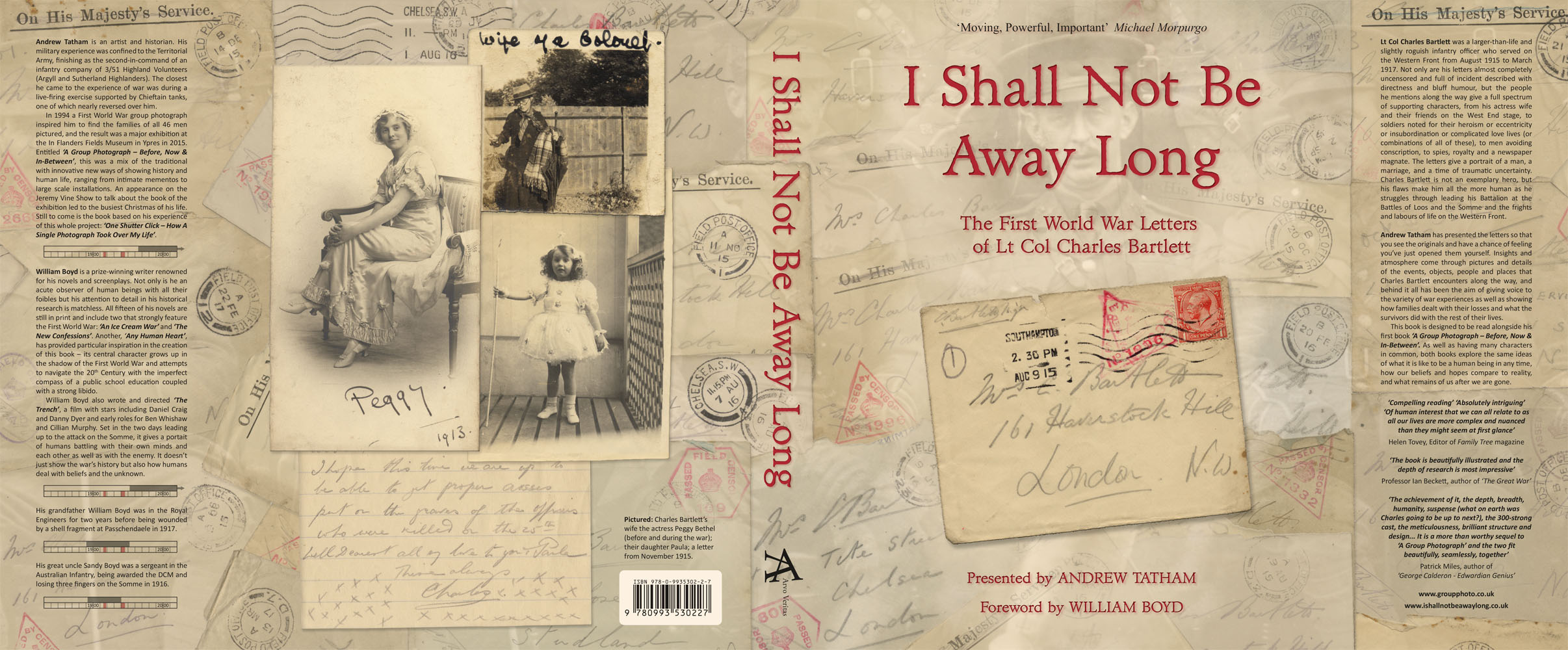
In January I met with the printers who did the reprint of my first book and things seemed set fair for being able to print whenever I wanted to proceed, and the price seemed about what I had estimated. I returned home to get on with adjustments to the book that came out of the meeting (including re-sizing to ease readability, and with 464 graphically-laid-out pages any change like that is not a short job). I also had another go at the cover and here is the outside of the whole thing (including flaps inside the front and back covers):


By the beginning of March I was fully committed to publishing the book myself and I got back in touch with William Boyd to see when he might be able to get his Foreword to me. In July last year when he’d agreed to write it, he said he was busy with other projects for the rest of the year (including finishing his new novel Trio which is coming out this October) but that 2020 looked clear. Things were already starting to get interesting on the Covid-19 front when he agreed to a deadline of 1st May to send me his Foreword and then three days later we went into lockdown.

Given that I spend a lot of time on my own in my hermitage working on my stuff, lockdown was not a huge change on the face of it – though, being somewhat rebellious, when I was being told I had to spend time on my own I then didn’t want to do it! But like so many of us, do it I did and I recognised that I am luckier than a lot of people in being able to continue with my work mostly safe from the risk of infection and finding solace in the natural environment around me on my officially sanctioned walks.

One of my jobs at this time was sorting out permissions for some of the pictures I was using in the book. For the most part I have aimed to use pictures that are out of copyright or for which relatives had given me permission but that wasn’t possible for all and I could only fully sort out permissions for the rest when the decision was made about publishing. Some institutions recognised the fact that I was self-publishing by waiving their fees in return for a copy of the book, but still I had to pay out a total of £342 for the use of 6 of their pictures from the National Portrait Gallery and Imperial War Museum who aren’t much interested in helping out the little guy. It’s a wonder that any book is produced that has pictures in it, given the cost and difficulties concerning permissions.

At the end of April, William Boyd sent me his Foreword. To give you a bit of background: I have read every single one of William Boyd’s fifteen novels, starting with ‘Brazzaville Beach’ which was given to me by my sister for my birthday some time in the 1990s. In particular ‘Any Human Heart’ has a special resonance for me. I remember reading it in a hostel in Adelaide during my research trip to Australia in 2003. I was having a difficult time and it enabled me to escape into another life, but it wasn’t just escape reading – I connected with its whole life story of sudden ups and downs, the attempts to navigate a path guided by ideas learned from family and public school and by urges and feelings often not understood, and it gave the idea that ‘anything is possible’ which would later come to me as the most important learning from my Group Photograph project. And now here was William Boyd writing the Foreword to a book of mine and not only that but being bowled over by what I had done and praising it to the hilt. You can read the whole Foreword in the sample pages from ‘I Shall Not Be Away Long’ but one comment that is not in there is ‘No professional publisher could equal what you’ve done here.’

It is often hard to gauge the value of one’s own work. Family and friends may be biased or not want to discourage you with unwelcome truths, and criticisms can cut deeper than they should though they may be the view of only one person, but there is no way that William Boyd would have written what he did without meaning it and his saying that I had ‘really created something remarkable’, along with the prediction of a great success, was the most colossal boost.

With confidence high, I went back to my printers to start the ball rolling only to be faced with the new not-normal of most of their staff being on furlough, and not only them but also their binders. In the first instance I ordered a bound blank copy, just with the cover printed so I could see how it all fitted together with the paper I had chosen. In the event, even just that took a month to get through, but in another example of unwished-for things turning out to be for the best, that delay led to me deciding to do one final run-through of the whole thing, checking and editing, and with so much having been unread for many months that enabled me to approach it with a (nearly) fresh eye and make some changes that made me feel at last that it was the best that it could be.

I ordered proofs of the whole book and ironed out the issues that arose from them (there’s a short sentence for a not entirely straightforward process) and then there I was, ready to set dates for printing. On 9th October I will tell my printers how many copies I want and then on 11th November this book will be published and ready to be posted out. Sounds simple but boy is this venture full of risk involving sums that are not remotely comfortable to me (to get an idea of what is involved see this document about the economics of it all). In the end I’ve decided on a price of £29.50 (inc P&P) – not cheap but then this is a large high-quality book and not a bad price for what is basically a time machine (and you’d certainly pay more for a similar book from a book shop). You can pre-order your copy now from here, which also includes the option to get your name in the book as a supporter and get access to my artwork films from my Group Photograph project.

Starting my campaign to take pre-orders has been nerve-wracking but as always I’m sustained by the kindness and generosity of people who really support what I’m doing – and in another example of things happening that couldn’t be predicted, William Boyd put me in touch with a longstanding and very well-respected publicist friend of his who is now working on my campaign (as in this press release). I couldn’t be in better hands as I embark on this next adventure.

PS If you’re not tired of my writing, you can see more thoughts and stories from ‘I Shall Not Be Away Long’ in this guest post for my friend Patrick Miles’s blog.


Monday, 25 November 2019

A new book - and there is some very good news

For the past two years I have been absorbed in researching, writing and laying out a new book. It has been another typical Andrew Tatham project where I've started out with what is on the face of it a simple idea and it has morphed into something that has required an enormous amount of legwork and taken over my life. The simple idea was to present a book of the letters of Charles Bartlett, my great-grandfather's second-in-command from the Group Photograph. Charles Bartlett is a larger-than-life and rather roguish character and the letters are almost completely uncensored and full of incident described with directness and bluff humour. I'd had the idea of making a book from them almost from first sight nearly 20 years ago but it had had to be on the back burner as I focused on what I was doing with the Group Photograph as a whole in the lead up to the exhibition in Ypres. When I turned my attention back to the letters, I thought it would be interesting to see what I could find out about the people he mentions in them, that that would give more of a feel for the wider landscape in which his life was being lived. The thing is that he mentions some 300 people in the letters, but never one to be daunted by idiotic challenges, I set up a spreadsheet and off I set.

What could have been a chore turned into a constantly surprising voyage of discovery into the past. Charles Bartlett had worked as a private secretary in the Theatre before the war and his wife was an actress and singer on the West End stage. Names in the letters that at first sight meant nothing to me turned out to be some of the biggest names in Edwardian Theatre with larger than life stories to match. Being in the war-time Army brought him into contact with all sorts of people from many walks of life who he would otherwise never have met, and being a senior officer meant that that included a full spectrum from private soldiers up to generals. As with my first book, I wanted to turn the names into human beings and kept digging until I found something that evoked some kind of uniqueness in the lives being led. And the stories that kept popping up were incredible, with people who were noted for their heroism or eccentricity or insubordination or complicated love lives (or combinations of all of these), to men avoiding conscription, to spies, royalty and a newspaper magnate. Through it all, I wanted to give voice to the variety of war experiences and show how families dealt with their losses and what the survivors did with the rest of their lives.


When it came time to start writing and laying out the book, I decided I wanted to make it visual to give an atmosphere of the times and places and people of the letters. Key to that was using scans of the originals with their handwriting and the feel of the writing papers with all their different colours and textures and shapes. Still, I wanted it easily readable so after experimenting with ways to overlay the letter transcriptions and combine them with the visuals and the notes about the content, this is what I came up with:


page 206

page 262

Believe me, doing that for a whole book with over 300 letters was not a small task. It took me months. In the end, though, I felt the effort had been worth it. Of course that meant nothing if it didn't speak to anyone else and it was with some trepidation that I sent it out to my first readers. My first first reader was my friend Patrick Miles (author of 'George Calderon - Edwardian Genius'). His response was beyond enthusiastic and can be measured by the fact that he asked me to confirm that he was indeed the book’s first reader because he thought his descendants would be proud as he was sure it would become a classic. I am so lucky to have had that to hold on to as I face the hurdles towards publication.

With the feedback from my first readers showing that I was on the right track, I then did some editing as well as cleaning up  the visuals (painstakingly cutting out the edges of the letters from the scans took three months on its own). In the background whilst I was doing all that, I was also looking at how I could get my book to stand out so that it might have a chance to catch the eye of publishers and prospective readers. Interesting content is not enough, particularly if neither the subject nor the author is a household name - and on the face of it a collection of First World War letters might not seem of more than niche interest. How could I show there was more to it? I'd seen other books with esteemed people writing the Forewords so I set to finding my Esteemed Person. 

William Boyd had chosen my first book as one of his Best Books of 2016 in The Guardian and I thought he would be the perfect person because his novels are full of acutely observed human beings with all their foibles, and his attention to detail in his historical research is matchless. It is also obvious that he has a keen interest in the First World War given that he wrote and directed ‘The Trench’, starring Daniel Craig. To my absolute delight he agreed to write the Foreword. He was involved with the end game of his latest novel as well as TV and theatre projects, so he couldn't address this immediately but I'm looking forward to seeing what he writes about Charles Bartlett and his letters.

I then sent my book out to a few other Esteemed Persons in the hope that they would give me some useful feedback. Some got back to me to say that they didn't have time to read more than the few pages I'd printed out for them (I knew it was a big ask to expect them to read the PDF of the whole thing from a memory stick) but still, even in their busyness, they took the time to say some really helpful and encouraging things. Three who did read it have given me a huge leg-up. 

Professor Ian Beckett had helped me out with some research questions I'd had with this book and not only did he read the whole thing and point out what he thought was of particular value and interest but he gave me a an confidence-boostingly small list of minor corrections to make. It will mean a lot when approaching publishers to be able to say that someone so eminent has effectively peer-reviewed the military and general history of the content.

Helen Tovey, editor of Family Tree magazine, responded with great enthusiasm, saying that the letters made 'compelling reading' and that even though she had no connection to Charles Bartlett she found his story 'absolutely intriguing' on a human interest level, and as an example that 'all our lives are more complex and nuanced than they might seem at first glance'. It is that sort of idea that is at the heart of what I do, that by looking at the specifics of other people's lives we can see universal ideas that we can apply to ourselves.

I wrote to Sir Michael Morpurgo more in hope than expectation and was beyond thrilled when I returned home from a trip away to find a postcard from him on my doormat, thanking me for sending him the book and saying that I could use his words when contacting publishers - and his words were 'moving, powerful, important'. If that doesn't catch a publisher's eye, I don't know what will. And even if it doesn't, it's going to open up all sorts of possibilities when self-publishing. 

The First World War Centenary may be over but it seems that reminders are still needed of where prejudice and aggressive rhetoric can lead. Maybe my book won’t change the world, but I’d like it to have a chance to do its bit. I hope it won't be too long before you see a book which might look something like this:


The cover

Friday, 8 December 2017

An anniversary, and a comfort to the sick

Today is the second anniversary of my first chat with Jeremy Vine on the radio. The funny thing is, though, that I have only just recently realised that today is also a very significant anniversary within the story of my project. When I was speaking on the radio about the marriage of Will Bissley to his childhood sweetheart Mu, I was unaware that it was 100 years almost to the hour that their wedding took place. It's amazing that the wedding ever took place. Mu was born in Shrewsbury, 120 miles away, and only moved down to Will's home town of Maidenhead when she was nine, after the death of her father. Even when she joined the church choir and her eyes met Will's the path of true love was not clear. They were of different social backgrounds (her father had been a vicar and his father was a local builder and developer) and in those class-bound times, they were not allowed to talk to each other. They got round this by exchanging little notes via his cassock pocket hanging up in the vestry, and by whispered conversations through her garden fence - and eventually by the time of the War things had developed so that they were able to get married. I have told the story many times of their brief marriage and the miraculous growth of their family in his absence after the Battle of the Somme, but on their anniversary today I think it is worth remembering the possibilities of life as shown by their family tree (see description below):


After Will was killed, you can see his daughter growing to the left and then all the shoots of new generations growing above - 26 lives that couldn't have existed but for their chance meeting.

Our lives are changed by the people we meet along the way and some of those meetings only show their true significance long after they occur. In 2006 I took part in Norfolk Open Studios. I remember being frustrated by the small number of visitors who came but in the long term I have grown to realise that it's not how many but who it is that counts. Patrick & Alison Miles were up in Norfolk on holiday and I'll never forget Patrick's reaction as he emerged into the light from my shed cinema having watched my animated film based on the Group Photograph. He was clearly moved and fully engaged with what I had done, and that initial enthusiasm carried over into us staying in touch over the years. He wrote a lovely review of my book on his blog early last year, and since that time we've been geeing each other along through our attempts to navigate the publishing world. And then out of the blue I got an email saying that he and Alison had decided to give my book as presents this Christmas and could I organise a bulk order. I'm not giving anything away to any of his family and friends as Patrick has already let the cat out of the bag on his own blog where he has given full expression to his enthusiasm: www.patrickmileswriter.co.uk/calderonia/. So many people seem to live their lives without the curiosity and enthusiasm for the new that is Patrick's trademark, and I am glad that he found me. (And if you would like to make your own bulk order, a box of 10 signed books is £180 including delivery, a saving of £38 on ordering individually - send me an email on andrew@groupphoto.co.uk and we'll sort out the arrangements).

None of what I've written so far explains the "a comfort to the sick" part of the title of this post. Well, last week I had a text from a friend saying that her son (who is 13 years old) was home from school with a sickness bug and was asking for water and a copy of my book (!). Unfortunately she'd loaned out her copy and could she buy another one for him, and when could I bring it round? Of course I dropped everything and drove round (what author wouldn't?) and was even more touched when she told me that he insisted on not seeing me as he didn't want to pass on any bugs to me. I don't know how significant my book was in his recovery, but everything about this episode in our lives made me feel better.

I'm currently playing the long game. All these books I had printed up are selling at a trickle but I am fully absorbed in researching and writing my next two books and, if I do it right, those two books will lead people back to my first book. I am given confidence by the amazing stories my research is uncovering and the love that people still show for my first book.

Friday, 24 March 2017

Saved by a six-year-old

On Sunday morning, a little boy and his mother came into the gallery where I'm exhibiting. They looked a bit uncertain so I went up to them and asked whether they knew what they were looking at. On receiving the answer "No", I gave them a little introduction. At first I wasn't sure how interested they were but they sat down and started to watch the projection. As they were looking at the lives of the men in the group photograph unfolding on the screen, they started asking me questions - and in the discussions that followed it turned out that just that morning the boy had been talking about wanting to do his family tree. Given that he can't have been more than six or seven years old, that was amazing enough but what was even more amazing was that he had decided that when he was labelling his tree, if someone had died in a war he would mark them in red and if they had survived he would mark them in blue - and that was the colour coding I have used in the projection that he was watching. I was so impressed with his interest and enthusiasm at such an early age that I decided to give him a copy of my book. He and his mother looked a bit stunned when I handed it over to them and I wasn't sure what they had made of that when they left. About half an hour later, I went up to another woman who'd just come into the gallery and asked her if she knew what she was looking at, and she said, "Yes, I've been pulled in here at the insistence of my grandson" and there standing behind her was the little boy from earlier. She thanked me for the book (and for the opportunity of lugging it around in her bag!), and with that I asked if I could write an inscription to him. He was called Wilfred, a good old name shared by two of the men in my group photograph, and I would love to know what he ends up doing. Interest and enthusiasm are such important keys to life and I hope that he gets the opportunity to make full use of them.

Wilfred certainly made an impact on me. I must admit to finding exhibiting difficult. I spend vast amounts of time working away on my own in my hermitage to produce exhibits - and then suddenly my work and I are propelled into the public eye where we are open to scrutiny (and also vast waves of indifference as so many people continue oblivious to anything not on the busy tracks of their lives or that requires a longer attention span than the blink of an eye). Coupled with exhaustion from the efforts of trying to get things done in time for the exhibition opening, I'd rather been struggling but that interaction with Wilfred knocked me out of my groove and I ended up having a really good day. I went up to anyone who came in and had interesting conversations with people originally from Brazil, Ethiopia, China, Lithuania (and even some from Norwich!) - and re-learned the truth that if you engage with people and ask them questions your eyes are opened to a whole different world as experienced by others.

I was also surprised by visitors who had come a long way to see the show, having bought my book online, swapped a few emails with me and followed my blog. Both had come up to Norwich just for the day and left lovely messages in my comments book. Maggie had come up from Surrey and wrote:

"What a superb achievement! I was as moved by the changing group photograph in this exhibition as I was by the book itself."

Lesley had travelled with her husband from Warwickshire and wrote:

"The photomontage is quite brilliant - very well worth all your effort in its creation."

It was a joy to meet them. The exhibition continues at The Forum in Norwich every day, 10 a.m. till 4 p.m., until Saturday 1st April. I will be in the gallery at least on Saturday 25th, Sunday 26th, Monday 27th, and Saturday 1st - and maybe on other days next week. Come and see what Wilfred saw.